· Xiaojing Yang · Explainability and Responsible AI · 5 min read
English样本级归因:Gradient Similarity、Influence Functions 与 TracIn
面向 NLP 的样本级归因方法比较:gradient similarity、influence functions 与 TracIn,以及它们的假设和局限。
核心观点
样本级归因很适合诊断,但 gradient similarity、influence functions 和 TracIn 估计的是不同意义上的 influence,不能混为一谈。
这篇属于 Training Data Attribution for NLP and LLM Research 系列。它既是我的研究笔记,也是面试准备材料:每篇文章都要帮我把概念讲清楚,连接到自己的 thesis,并说明哪些部分可以成为博士阶段的扩展。
核心问题: 哪些训练样本和某个预测或评估行为最相关?
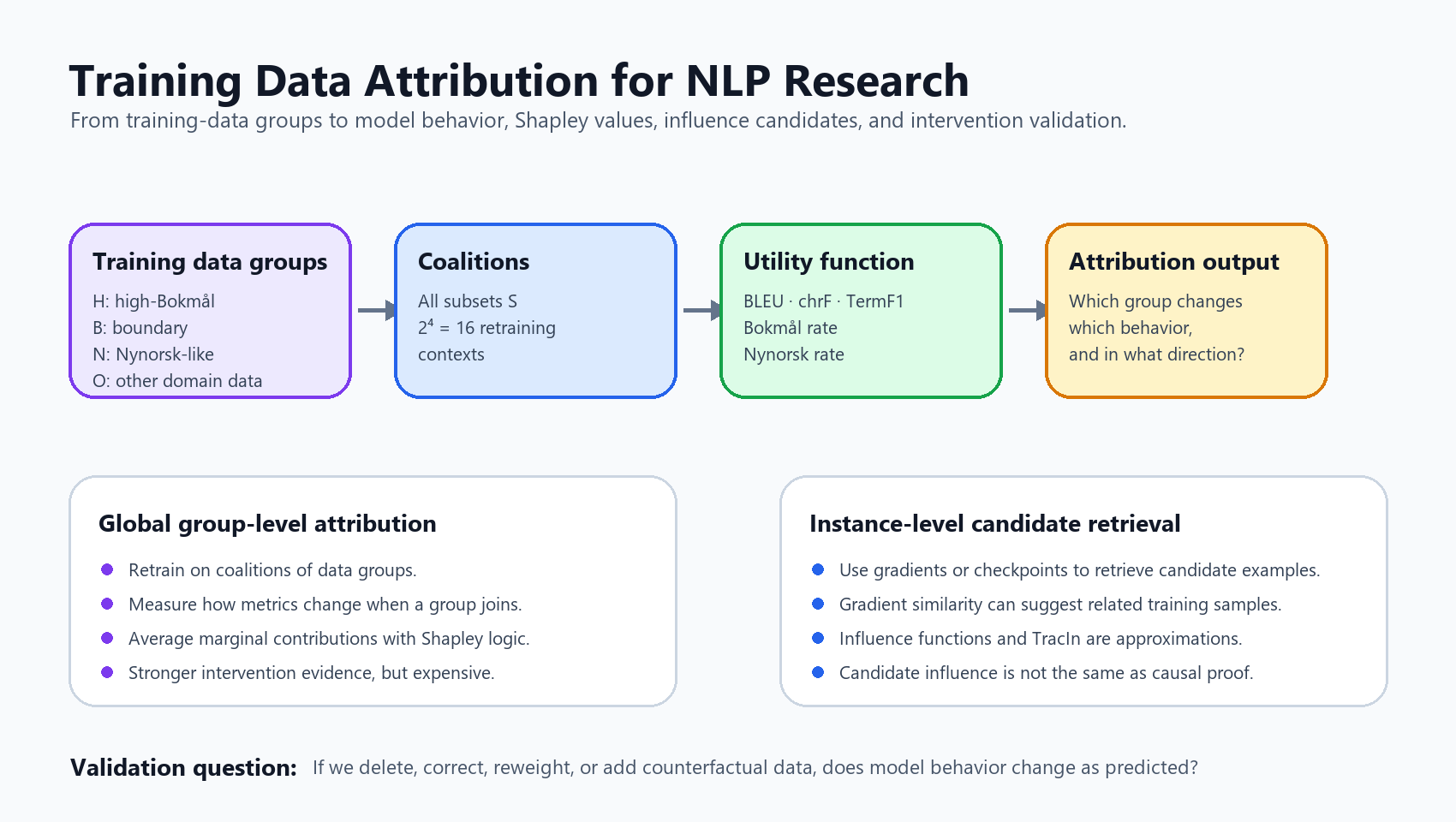
直觉
Gradient similarity 问两个样本是否会把参数推向相似方向。Influence functions 近似某个训练样本被上调权重后会怎样。TracIn 则跨多个 checkpoint 累积梯度对齐,避免一次昂贵的 inverse-Hessian,但依赖保存的训练状态。
这在 NLP 和 LLM 研究中特别重要,因为模型行为很大程度上由数据混合方式塑造。模型可能因为大规模网页文本而流畅,因为专业文档而领域准确,因为 curated instruction data 而更安全,也可能因为语料中重复出现的偏差模式而产生偏见。Training-data attribution 让我们可以系统地讨论这些问题,而不是笼统地说“数据很重要”。
形式化视角
Gradient similarity 常用 cos(grad_theta L(z_train), grad_theta L(z_test))。Influence functions 用 -grad L_test^T H^{-1} grad L_train 近似上调 z_train 对测试损失的影响。TracIn 跨 checkpoints 求梯度内积和,通常按学习率加权。
解释 attribution score 之前,必须先定义清楚实验设置:
| 设计选择 | 必须回答的问题 |
|---|---|
| Attribution unit | 谁获得贡献:source、group、document、example 还是 token? |
| Utility function | 解释哪种行为:质量、术语、风格、事实性还是安全性? |
| Intervention | 是加入、删除、重加权、修正,还是重新训练? |
| Estimator | 分数来自 exact、sampling、gradient、surrogate 还是 heuristic? |
| Uncertainty | 分数在 seed、样本、指标和评估集上是否稳定? |
NLP / LLM 例子
如果 MT 中某个石油术语翻译错了,基于梯度的检索可能找到术语或句法模式相似的训练句对。这对错误分析有帮助,但仍需要验证:被检索出的样本可能和错误相关,却不一定导致错误。
所以我不想把 attribution 写成普通可解释性教程。对我的背景来说,它最自然地连接到 multilingual and domain-specific NLP:低资源设定、技术术语、书面语标准差异,以及不止一个 headline metric 的模型评估。
和我的 thesis 的关系
在我的 thesis 叙事中,training-data attribution 的价值在于把模糊的数据问题变成实验设计:
- 定义可解释的数据单位;
- 定义要解释的模型行为;
- 比较受控的数据 coalition 或 intervention;
- 估计贡献;
- 报告不确定性和局限;
- 判断证据是否足够支持更强的因果式表述。
这个结构能帮助我避免 overclaiming。一个分数不会自动成为因果解释;它是特定设置下得到的测量结果。
我已经完成、理解、以及博士阶段可以扩展的内容
| 层次 | 状态 |
|---|---|
| 已完成 / thesis-ready | Group-level attribution、coalition thinking、基于指标的 utilities、谨慎解释、random baselines、bootstrap-style reliability checks。 |
| 理解但未必完整实现 | Instance-level gradient attribution、influence functions、TracIn、Monte Carlo Shapley、surrogate/datamodel approximations。 |
| 很适合博士扩展 | Hierarchical attribution、intervention-based validation、factuality/style-specific utilities、面向 LLM 数据混合的 scalable attribution。 |
面试回答版本
我会清楚区分这些方法。Gradient similarity 更简单便宜;influence functions 更接近因果干预思想,但依赖较强近似;TracIn 是基于 checkpoint 的实用替代。对我当前工作来说,样本级方法是 group-level attribution 之后的诊断扩展。
参考资料和阅读路径
- Lloyd Shapley, A Value for n-Person Games.
- Ghorbani and Zou, Data Shapley: Equitable Valuation of Data for Machine Learning.
- Koh and Liang, Understanding Black-box Predictions via Influence Functions.
- Pruthi et al., Estimating Training Data Influence by Tracing Gradient Descent.
- Ilyas et al., Datamodels: Predicting Predictions from Training Data.
- Rei et al., COMET: A Neural Framework for MT Evaluation.